Showing posts with label Macro. Show all posts

Tuesday, March 6, 2012

HDR in Macro Photography?


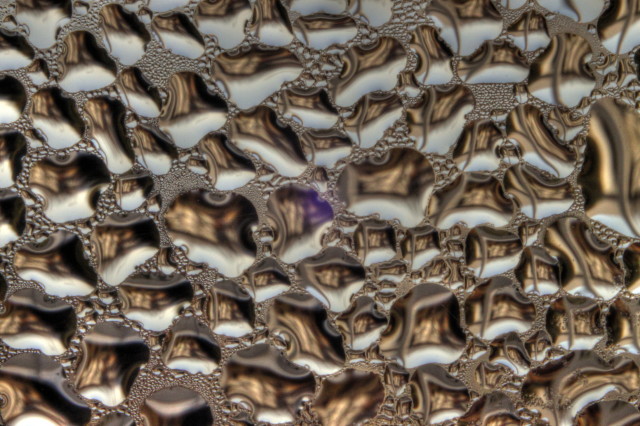
Even though HDR is usually associated with landscape photography I have applied the same technique to macro shots. When I came across a water condensation on a window pane that was facing sun about an hour after sunrise (sun was very low) and the sun was reflected in water drops I knew that I will be dealing with very high dynamic range of light. The clear sky sun was magnified in the water drops while the background was very dark reflecting dark street and lawn in front of the house. I fired sequence of three shots (normal exposure, +2 and -2 stops) and then I have processed these shots in Photomatix Pro 4. The setup for shots were exactly same as in my previous blog from February 12th on macro photography. Actually, the water drops were in the very same spot. The photo generated by Photomatix was cleaned up in Photoshop Elements 10 and rotated 180°. Finished image looks like a shot from Sci-Fi movie.
Here is one of un-retouched photos that I have used.

Since I had my macro gear out I took few more shots, this time of condensation that was bunched together. For steadying my camera I used bag filled with lentils, it makes an excellent “tripod” that I use for my ground level shots.
The setup.

Bean bag is so useful!

Saturday, February 25, 2012

More Closeup and Macro Photos

Hollyhock Seed

Nasturtium Seed

Another Snowflake 

 Center of Crown of Thorn flower

The closeup image is inside the white circle.

Photographing Vegetable Seeds

As I was fruitlessly waiting for another snowfall so that I could improve my technique to shoot individual snowflakes I was wondering what else I could photograph with my macro setup. As luck would have it I spotted vegetable seeds packets that were out on table for indoor planting next week. I have never looked at seeds from really close so I was blown away how colorful some are. In order to get decent magnification I used 21mm and 31mm extension tubes and for light I used Minolta 4 tubes ring flash with only left tube turned on.

Thai Chilli seed

Red Pepper seed

Red Radish seed


The setup.

Thursday, February 23, 2012

Photographing Individual Snowflakes


I have finally managed to photograph individual snowflakes with DSLR camera. Years ago I have made nice images with my old Minolta attached to microscope but microscope just doesn’t work all that well with my Canon EOS, I don’t know why. For these shots I was using Minolta 50mm 1:1 macro lens with MD/EOS adapter ring and 2X macro extender, focusing rail, off-camera Speedlite in manual mode and heavy-duty Manfrotto tripod. Aperture, shutter speed and focusing were all manual. For capturing the snowflakes I used black steel chalkboard that was cooled down for few minutes in a freezer and then placed in open area on the deck. When I had few snowflakes on chalkboard I placed it under the lens that was already pre-focused. This way I had to do only minimal re-focusing when I moved the board around. As you can see on picture of my setup, it was 0°C (32°F) when I took my shots and shortly after the snow turned to rain. We have very un-usual winter here in Southern Ontario, not too many opportunities to play around with this technique.

Very wet snow.

All snowflake pictures were shot @ ISO 100, f/11@1/200, Speedlite flash with difuser@1/2 power. Macro lens extender pushed the aperture to f/22


Tuesday, February 21, 2012

Photographing Water Drops on Window Pane

ISO 100, 50mm 1:1 macro lens with 2X macro extender, f/16 @ 1 sec., natural light.

Last fall I was experimenting with shooting close-ups of water condensation on window pane. Since I was using macro lens at 2:1 magnification ratio (double life-size image) I can safely consider this as micro photography. At this magnification it can be a problem to get sharp focus since depth-of-field is very shallow and the water drops are half of a sphere. I had to go all the way down to f/16 with aperture to get sharp images. Because of that, focusing rail is essential for really sharp image.
The photographs of water drops and set-up were done few months apart, as you can see. There is a snow on the ground on set-up pictures but looking through water drops on window pane there is very green grass .

In order to get close to window and water drops I had to place 2 legs of tripod on window sill and third leg on the floor.

Camera mounted on focusing rail.


Image flipped 180 °.

Sunday, January 22, 2012

Another Winter Project

As I was thinking few days ago where I am going to set-up my microscope mounted with camera to photograph single snow flake I received email from my blogger friend challenging me to do just that. What an incredible coincidence! Looks like we shutterbugs think alike. So, out I went, let the microscope and slides cool down to below freezing temperature, got the lights set up and started collecting snowflakes. But I was out of luck. The snow we got overnight was more like a frozen fog and all I saw was tiny ice crystals that reminded me of sea salt. Eureka! I will shoot salts instead, who knows, it might even make a decent image. Well, it wasn’t to be. It was interesting but I am not sure I would print them. Still, here they are.
I have expected to see beautiful, clear crystals but what I saw looked more like sand. (Oops, another macro photography project: sand. That one has to wait few months, though). I will be watching weather forecasts for some nice heavy snow, I am all set up and ready to go.

Himalayan Pink Mountain Salt Crystals are the same size as regular table salt.
50mm macro with 2X extender and 31mm extension tube, f/22, ISO 400, lighted by 1,030 lumens halogen spot light. Focus was assisted by macro focusing rail and focused in live view zoomed down to maximum and 2 sec. shutter delay.

Coarse sea salt, same camera settings as above.
Setup.