Showing posts with label HDR. Show all posts

Wednesday, May 2, 2012

Another Countryside Sunrise


One more HDR processed image. It is almost impossible to capture a decent sunrise without shutter bracketing at least 3 photos. For this shot I used 5 photos: Normal, +1.5, +3, -1.5 and -3 stops. For tone mapping I used Photomatix Pro v.4.2.

Friday, April 27, 2012

Time-Lapse Photography – First Experiment

Few weeks ago I have ordered intervalometer for my camera to try my hand at time-lapse photography. As is the case with most photographers that try this technique for their very first time, my first subject was moving clouds. I tried straight time-lapse and HDR time-lapse and was blown away how dramatic HDR sequence was! On second look I have realised how often I have seen HDR time-lapse clouds on television, especially in opening scenes for a golf tournaments. People that do not know about HDR photography just see great looking dramatic images without realising that there is quite a bit of computer “magic” involved. Photographers that are familiar with High Dynamic Range technique know how much work and especially time it takes to come up with a 10 seconds long sequence. Every HDR frame takes 3 images (normal, underexposed and overexposed frames) and every second of movie takes 24 frames.
24 x 3 x 10 seconds = 720 exposures. Yes, 720 photos for 10 seconds “long” movie.

This video is 4 seconds long and was taken with 1 frame evry 4 seconds.

HDR time-lapse.

Tuesday, March 20, 2012

Sunrise on First Day of Spring (Vernal Equinox)

When I looked outside this morning about half an hour before sunrise I thought that it will be just a regular partly cloudy day show. I packed my gear and headed out anyway and I wasn’t disappointed. What struck me, though, was that sky directly opposite to sunrise (due west) was more spectacular than actual sunrise once the sun got over the horizon.

 
Sunrise at 7:30


Western sky at sunrise at 7:39. Notice the long shadow of my tripod and a car. It is impossible not to have the shadows in a photo with the sun directly behind me. The shadows were about 75 yards long!

Monday, March 12, 2012

Stormy Clouds

This morning I was checking the weather radar on Internet and saw big storm coming. One look outside got me scrambling to grab my camera and head to countryside to get shots of some most incredible clouds that I have seen in a long time. Some actually looked like that a tornado funnel was forming. Interestingly enough all we got was rain and very little wind. As soon as it started to rain, all the clouds turned into a regular gray sky. I was lucky to capture them, they lasted only about 15 minutes.


Tuesday, March 6, 2012

HDR in Macro Photography?


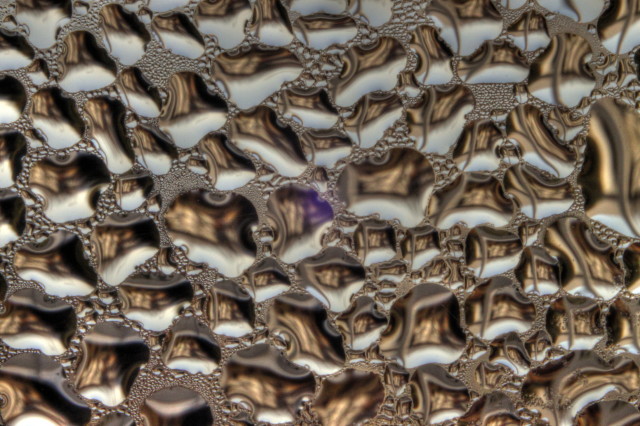
Even though HDR is usually associated with landscape photography I have applied the same technique to macro shots. When I came across a water condensation on a window pane that was facing sun about an hour after sunrise (sun was very low) and the sun was reflected in water drops I knew that I will be dealing with very high dynamic range of light. The clear sky sun was magnified in the water drops while the background was very dark reflecting dark street and lawn in front of the house. I fired sequence of three shots (normal exposure, +2 and -2 stops) and then I have processed these shots in Photomatix Pro 4. The setup for shots were exactly same as in my previous blog from February 12th on macro photography. Actually, the water drops were in the very same spot. The photo generated by Photomatix was cleaned up in Photoshop Elements 10 and rotated 180°. Finished image looks like a shot from Sci-Fi movie.
Here is one of un-retouched photos that I have used.

Since I had my macro gear out I took few more shots, this time of condensation that was bunched together. For steadying my camera I used bag filled with lentils, it makes an excellent “tripod” that I use for my ground level shots.

The setup.

Bean bag is so useful!

Friday, March 2, 2012

Wonders of HDR

Here is my very first try at HDR, #1 tee at Tillsonview Faiways.

 Anybody that has taken picture of sunset or sunrise knows that what your eyes see is nowhere near what your camera see and records, be it film or digital. When I was doing my own developing in a darkroom it took long time and lot of trial-and-error to come up with a decent picture resembling what you have seen. With digital camera and HDR (High Dynamic Range) software it is done in minutes. Of course, if you want a really, really good picture it takes a lot longer since there are so many options. The way it works is that you take at least 3 shots (normal exposure, under exposed and over exposed) and then combine them in software. Sturdy and solid tripod is a must since the images have to be identical. There are lot of sources on Internet dealing with HDR but here is my favorite on Nature Scapes Net.
 
Here are 3 shots that I used to create my image.

Normal exposure (there was heavy overcast)

Plus 2 stops

Minus 2 stops